Data analytics and AI
Higher education data analytics and AI
Use AI on approved campus data with institution-owned definitions, permissions, methodology, and human review on the same managed platform.
Explore data analytics and AIAt EDUCAUSE 2026? Bring one report your team rebuilds every term.Book a 20-minute working session.
Start with enrollment, student success, institutional research, or another campus priority. Doowii serves as your AI data team, running the platform and ongoing work end to end as the data and use cases expand.
 Built for higher education
 IPEDS peer benchmarking
 SOC 2 Type II report
Start with a specific program, enrollment, retention, reporting, or governance priority, then expand on the same managed platform as additional teams, systems, and workflows come into scope.
Data analytics and AI
Use AI on approved campus data with institution-owned definitions, permissions, methodology, and human review on the same managed platform.
Explore data analytics and AIPlatform comparison
Compare Edify's platform and service levels with Doowii's managed platform and AI data team, including who operates the foundation and delivers the work campus teams use.
Compare Doowii and EdifyEvaluation guide
Compare the data foundations, analytics suites, AI layers, and managed operating models institutions evaluate for campus data work.
Compare platform alternativesStellic analytics
Keep Stellic for student workflows. Use Doowii as the AI data team across Stellic and the rest of your campus systems.
See how Doowii fits with StellicEnrollment management
Connect recruitment, application, admission, deposit, registration, and census context for timely enrollment planning.
Explore enrollment analyticsStudent success
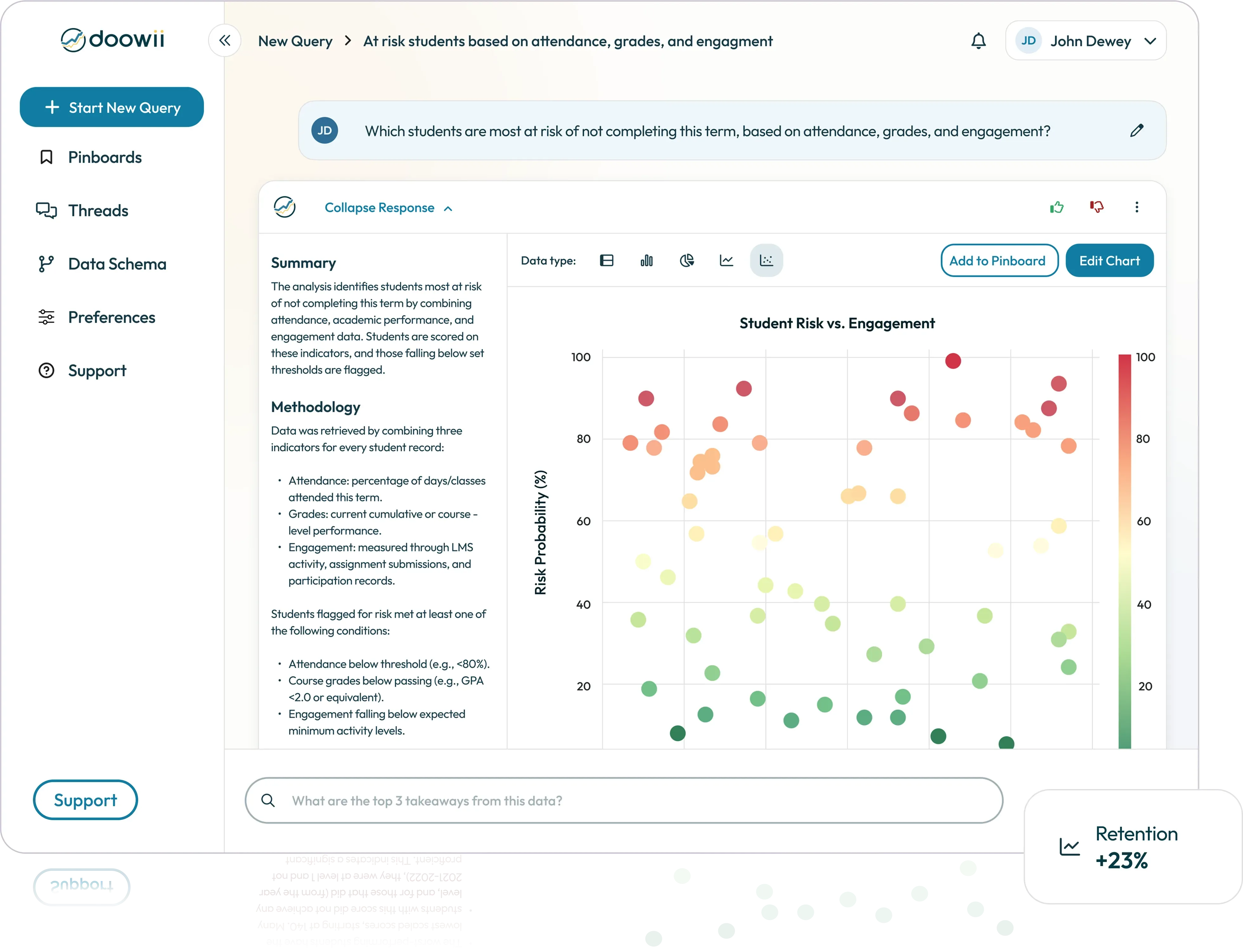
Connect academic, engagement, advising, and account context for governed persistence analysis and coordinated human review.
Explore retention analyticsAcademic affairs
Connect enrollment, course progression, completion, and program structure for governed academic planning and review.
Explore program analyticsInstitutional research
Build repeatable reports from shared campus definitions and keep the underlying data ready for the next leadership question.
Explore institutional reportingData strategy
Put ownership, definitions, access, quality, and lineage into practice across approved analytics, reporting, and AI workflows.
Explore data governanceCampus systems
Bring approved SIS, LMS, ERP, CRM, assessment, warehouse, and local data into one managed platform.
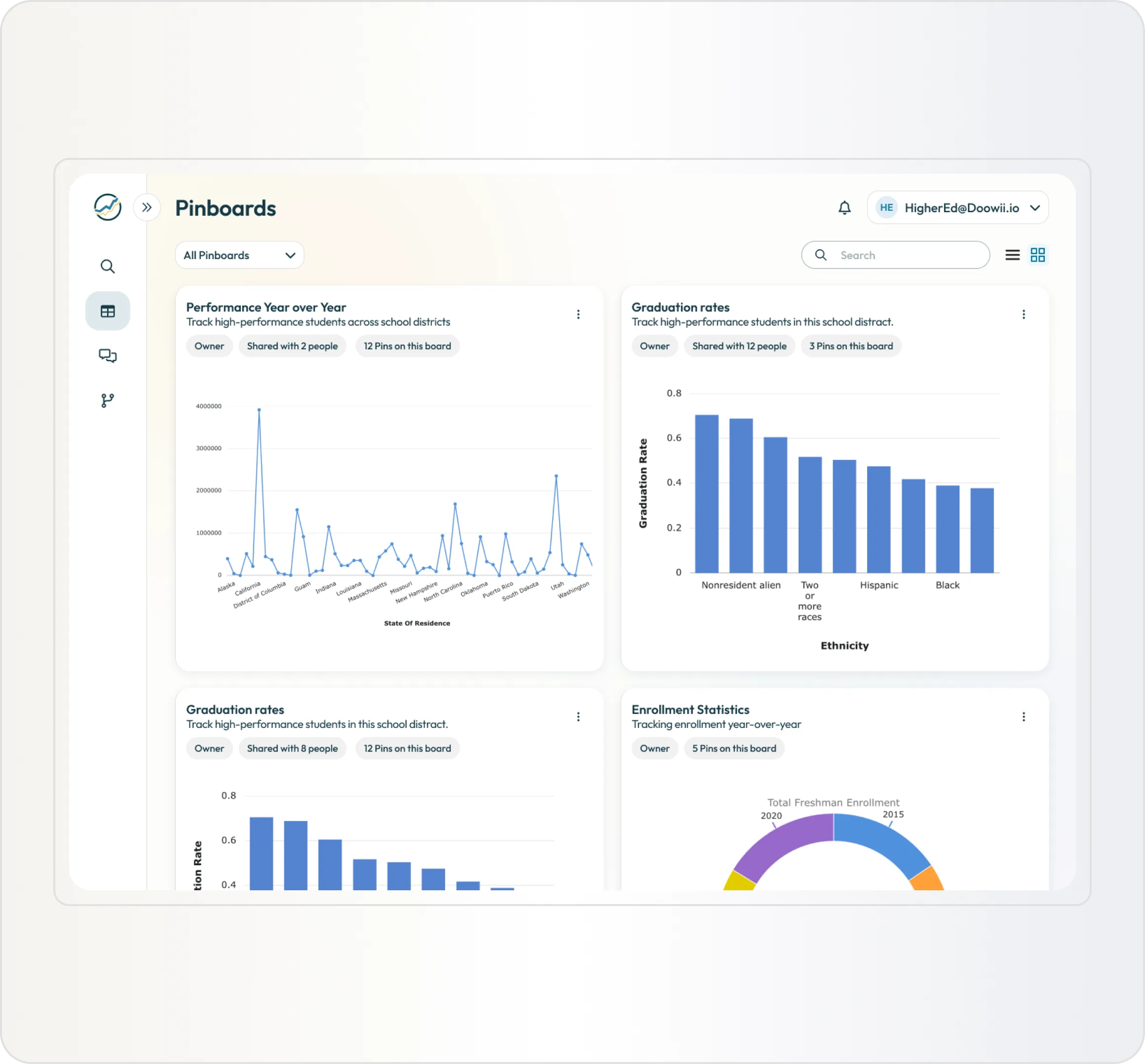
Explore data integrationDoowii brings the systems relevant to each workflow onto one governed platform so teams can investigate trends across sources. IPEDS data can add peer context to institution-defined metrics, helping leaders understand both the comparison and the methodology behind it.
Doowii is purpose-built for education across teams and workflows, not as a generic business-analytics model forced onto academic realities. The same platform supports K-12 districts, and Doowii maintains a SOC 2 Type II report.
| Consideration | General-purpose data stack | Vendor-native analytics | Doowii |
|---|---|---|---|
| Starting point | Flexible infrastructure that an institution or partner configures for its industries and use cases. | Analytics organized around the vendor's product ecosystem and data model. | A unified education data platform configured to the institution's systems, definitions, and workflows. |
| Cross-system work | Broadly possible; connectors, models, and education context are selected and assembled for the environment. | Often most streamlined inside the native suite; external-source options vary by product. | Connection plans are scoped across the SIS, LMS, ERP, CRM, assessment, and local sources needed for the use case. |
| Shared meaning | The institution designs education metrics, semantic models, and governance conventions. | Begins with the vendor's model, with configuration options that vary by product. | Begins with education context, then maps metrics and terminology to local practice. |
| Operating responsibility | The institution and its implementation partners generally operate the assembled stack. | The vendor manages its product; the institution coordinates work beyond that environment. | Doowii manages the platform end to end in partnership with institutional data and technology stakeholders. |
| Path to a governed use case | Depends on architecture, integrations, modeling scope, staffing, and governance readiness. | Can be efficient within the native ecosystem; broader use cases may add configuration work. | Starts with selected priorities and expands as sources, definitions, permissions, and outputs are validated. |
Actual capabilities and responsibilities vary by product, contract, architecture, and institutional requirements.
Enrollment, student success, institutional research, advancement, and leadership can work from the same connected data while keeping the context and access each role requires.

Which sources provide students most likely to enroll? Which students are at risk of not matriculating in the fall?
Which students are at risk to fail? Which course resources are being underutilized across campus?
Forecast participation rates by program. What kinds of campus engagement predict involvement after graduation?
Doowii is the unified data platform for higher education. It brings campus systems, shared definitions, governed access, analytics, reporting, and AI workflows together in one platform managed end to end.
Doowii scopes connections around the systems your campus runs, including SIS, LMS, ERP, CRM, assessment, and local sources. The exact connection approach depends on the system and implementation.
Doowii can incorporate IPEDS data so teams can compare institution-defined metrics with selected peer groups while retaining the underlying context.
No. Staff can ask questions in plain language and review the resulting chart, report, or dashboard. Institutional data leaders set definitions, access, governance, and review standards while Doowii runs the platform and repeatable analytical work.
Doowii maintains a SOC 2 Type II report. Its controls and privacy practices are designed to support institutions' obligations under FERPA, COPPA, CCPA, and other applicable laws.
Implementation timing depends on your systems, data readiness, governance needs, and initial use case. Doowii works with your team through a phased connection, definition, and validation process.
Yes. Stellic can remain the student-journey platform for degree audit, planning, advising, transfer, and registration. Doowii can work through the APIs, exports, files, or other approved data paths available to combine Stellic data with the broader institutional stack for reporting, analytics, monitoring, and AI.
Request a walkthrough tailored to your campus systems, teams, priorities, and representative higher-education workflows.